
By Aliko Munde
Perseverance, determination and hard work is what defined 48-year-old Mashaka Munkhondya as he plied his chips business at Budonda Trading Centre in Senior Chief Kameme in Chitipa district.
Munkhondya hails from Amon Kameme 7 Village in the area of Senior Chief Kameme in the northern border district.
Even as he plied his business at the trading centre, he restricted himself to one meal a day just careful not to find himself in the red margin of his business returns.
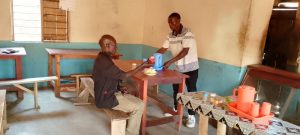
Life began to change after Munkhondya joined Tutulane, a Community Savings and Investment Promotion (COMSIP) group in 2022.
In February 2025, Munkhondya graduated from flying just chips to running a restaurant within the trading Centre.
“I used to make a profit of K60 000 per month when I was selling only chips by the road side. But with the new restaurant business I have established, I am able to post a profit of K150 000 per month,” Munkhondya explains.
He recalls that it used to be a challenge supporting his family of seven children with proper meals, and educational needs.
“Since I started this business I am able to support my household with food, clothes and all the school needs for my school going children,” he explains.
Munkhondya joined Tutulane COMSIP Cluster after he was taken through the concept of the group, and he was convinced with the group’s potential to empower and change families economically.
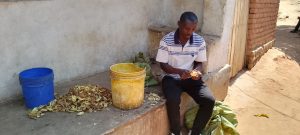
“In 2022-2023, I received K500, 000 dividends, which I used in buying 15 iron sheets, one bag of fertilizer, and I the rest of the money in my chips business,” explains Munkhondya, and he continues: “In 2023-2024 I received K700, 000, which I bought two bags of fertilizer, timber, nails, and wire for a guest wing building under construction.”
Malawi has one of the four highest poverty rates globally, with 70 percent of its population living on less than $2.15 a day, based on a 2019 household survey.
The survey’s findings are not surprising as the country ranks on 170 out of 187 countries in the Human Development Index, and rural poverty has increased to 57 percent of the population in the past decade, with 85 percent of the population living in rural areas.
In an attempt to deal with incorrigible poverty rocking Malawi as a nation, Malawi government, with support from the World Bank established COMSIP, a capacity enhancement initiative designed to inculcate a culture of savings and investment in both rural and urban communities.
COMSIP has given birth to several poverty reduction initiatives meant to improve the living standards of Malawians, especially those in the rural areas, like Munkhondya.
The programme was introduced to fulfill Sustainable Development Goal II, which is to end hunger, achieve food security, improve nutrition, and promote sustainable agriculture.
Chitipa District Community Development Officer, Haddy Mlenga, describes the introduction of Comsip as a game changer in saving culture.
Mlenga notes that most people in rural areas in the district are now able to understand the importance of saving culture.
“Most people in Chitipa district are able to save their money in groups, especially COMSIP,” Mlenga says.
He observes that most people in rural areas have acquired fixed assets like; houses, and livestock because of the saving culture.
“Under COMSIP members have built houses, started businesses like, cross border trade, restaurant, selling farm produce and even agribusinesses, among others,” he says.
The living proof of COMSIP’s impact in Chitipa is clearly reflected in one, Munkhondya, who has now more than doubled his monthly returns by diversifying from a chips seller only to a restaurant owner, feeding his tens of customers, and his family while he is making more savings for his personal economic growth.
