
By Wanangwa Tembo
In the flat beds of Bua River in the southern part of Kasungu District, Talandira Network, a community-driven initiative, has been harnessing the power of irrigation farming to cultivate a brighter future.
Food insecurity and poverty once seemed insurmountable for these communities in Senior Chief Njombwa’s area until recently when a group of 45 determined individuals resolved to turn their fortunes around, taking advantage of the overflowing Bua River which snakes right through their villages.
The group’s lead farmer, Triphonia Magwira, narrates the humble beginnings of the idea which dates six years back.
“Our network started in 2019 but our farming activities have largely been subsistence, and sometimes even failing to produce enough yield for food.
“We also formed village savings and loan (VSL) groups with the hope of transforming our lives, but it did not work because we lacked knowledge on how best we could run such enterprises,” Magwira says.
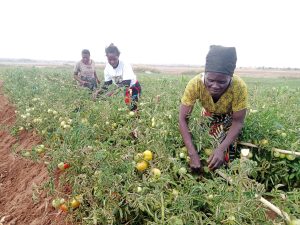
She says the deep poverty levels in the village manifested in their failure to support children in school, malnutrition, and general food insecurity.
Village Headman Nkhangaude, who has witnessed the group’s transformation firsthand, also recounts the challenges the community has been facing owing to entrenched poverty.
“We have for a long time relied on handouts, waiting for government to do everything for us. In the end we have been poor people all along.
“We have experienced perennial food shortages and we have failed to support our children in school. All we have known is poverty, but that is now changing,” he says.
With the help of expert training imparted by Financial Access for Rural Markets, Smallholders and Enterprise Programme (FARMSE), the network has now invaded the beds of Bua River, cultivating maize, legumes and other agronomic crops which are supplied to various off-takers, including the World Food Programme (WFP).
“We were trained by FARMSE on how to manage resources for prosperity, and it’s been a huge success.
“We’ve been able to cultivate tomatoes, maize, beans, and other legumes, and we are making a decent income from selling our produce to the WFP through the Schools Feeding Programme,” Magwira says.
She says before the training, members used to cultivate crops without a clear vision, and borrowing from VSLs was largely for consumption purposes.
“The training offered knowledge in business, resource and financial management, entrepreneurship, gender and sanitation.
“So, with that knowledge, we resolved to take farming as a business; that is why we procured three hectares of land along the Bua and a 2,000-watt solar irrigation pump and ventured into winter cropping,” she says.
With this investment, Magwira says the group has capacity to supply produce to markets sustainably throughout the year.
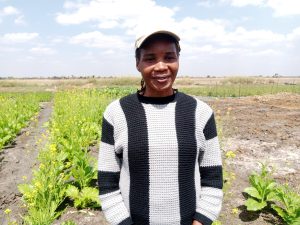 That aside, the group has also secured land where it intends to construct a warehouse as part of its ambitious vision of becoming a fully-fledged cooperative.
“We are proud of what we have achieved, but we are not stopping here. We are committed to continuing our work and inspiring others to do the same; we believe that, together, we can build a brighter future for ourselves and our community,” Magwira says.
Funded by the International Fund for Agricultural Development (IFAD), and Malawi Government, FARMSE, is a seven-year programme that aims to support the graduation of poor Malawians along the poverty spectrum from ultra-poor to a productive pathway on a sustainable basis.
The programme also supports household economic development through access to financial services that are appropriate to each socio-economic level of poverty, including ultra-poor, poor but food secure, vulnerable to poverty, and resilient to poverty, with a goal to reduce poverty, improve livelihoods and enhance the resilience of rural households on a sustainable basis.
According to another member of the group, Mkwezalamba Sungaunyolo, the acquisition of land along the Bua River, which boasts an abundance of water throughout the year, has enabled the group to sustain irrigation farming with ease.
“Our resolve to adopt solar pumps has proven to be a game-changer because it has eliminated the need for fuel and making it easier to manage resources.
“We used to water our crops with a small pump running on petrol. It proved expensive and unsustainable. This time we are safe,” Sungaunyolo says.
Adding: “We have been able to buy livestock, send our children to school, and even engage in village loans and savings groups. Poverty has generally reduced significantly, and we are proud of what we’ve achieved.”
He says the group’s vision for the future remains ambitious with plans to buy a tractor, and build a warehouse to further expand its operations.
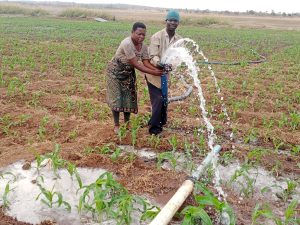
“We want to take our farming to the next level and we are confident that with the pace we have set, coupled with availability of reliable markets, we can become one of the leading farming groups in the district,” he adds.
Village Headman Nkhangaude is equally thrilled with what members of his community have achieved.
“I’m impressed and excited to see the impact irrigation farming has had on my community. This network is a shining example of what can be achieved when people work together towards a common goal.
“I am one person who does not like it when people are lazy and wait for the government to do everything for them. We must learn to be independent and this initiative here is a huge step towards self-reliance and prosperity,” he says.
FARMSE’s Knowledge Management and Communications Specialist, Golie Nyirenda, says Talandira Network’s hard work and dedication have paid off, with profits from their crops allowing them to invest in other areas of their livelihoods.
“Ever since we built their capacity in business and financial management, and the need to have a vision and work towards achieving it, it has been incredible to see their growth and success.
“They are a model to the power of community-driven initiatives and the impact that irrigation farming can have on food security and poverty reduction,” Nyirenda says.
She notes that people from rural areas have challenges to access financial services hence FARMSE’s other focus has been ensuring poverty reduction through promotion of financial literacy, and also bringing financial services closer to the communities.
“For instance, previously there was no proper management of VSLs where saving and borrowing were mainly for consumption and not investment.
“But after some sessions of capacity building, we are happy to see that now they borrow for investment – and an example is this irrigation farming venture. They take farming as a business and so, they plant throughout the year because they have a solar irrigation system,” Nyirenda says.
Despite its success, Talandira Network is ambitious to explore new markets for its produce to meet the production capacity and become a major player in the agricultural sector at district level and beyond.
As the group continues to thrive, their story serves as a reminder that even in the most challenging environments, capacity building, determination and hard work can lead to remarkable transformation of households.
