
By Leonard Masauli
Delipha Kalonde, 27, is among the leading tailors at Area 22 B in Lilongwe where her beckoning skills have created wonder clothing with a needle and thread.
Kalonde is a product of Don Bosco Technical Institute, which she joined in 2017 with support from Technical, Entrepreneurial and Vocational Education and Training Authority (TEVETA).
But although she graduated in 2021 with a Certificate in Tailoring and Design, and a sewing machine as start up capital, Kalonde had already established a business entity, Sunrise Tailoring & Designs Shop, in 2019 – two years before her graduation.
Her passion and skills won people’s trust such that the needle and thread wonders encouraged many people to believe in her, compelling many to get interested and to learn tailoring and designing.
This saw her playing multiple roles as trainer, designer and tailor, earning great recognition and admiration from the community and beyond.
“From the proceeds that I earned through the training of others, I managed to employ two people to help me with the work,” explains Kalonde, and she continues: “TEVETA also started sending trainees for mentorship and I train them for six months from January to June; and another cohort from July up to December.”
So far, Kalonde, married and mother of one, has managed to train 50 young tailors who are currently running their own shops and doing well just like their trainer – or even better.
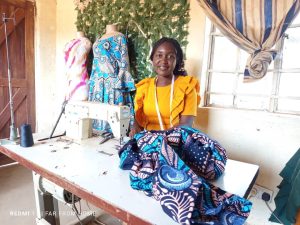 Kalonde’s tailoring business is getting more established by the day and, currently, she has 15 sewing machines, most of them electric, and her products have reached far and beyond the continent.
In a world where fashions keep changing every day, adapting to trends on the market is a must for Kalonde to keep her business afloat and flourishing.
The determined tailor and fashion designer uses the internet to update her Facebook followers with some new fashion trends and this has helped Kalonde find market overseas.
“My products have attracted customers living abroad: l design and make outfits of their choice and ship through DHL to countries such as America, UK, and Australia, just to mention a few,” explains Kalonde.
One of Kalonga’s diaspora customers is Australia-based Andew Chimalizeni, who speaks highly of Kalonde’s products which he wears as part of showcasing the authentic Malawian clothing to the world.
“I am very happy with her skills. I wear the clothes I got from Sunrise Tailoring at functions where I want to highlight my heritage and showcase authentic Malawian clothing,” explains Chimalizeni through a WhatsApp interview.
“In addition, she is professional in her work and I would recommend her to anyone who would like to get quality tailored clothing,” he adds.
With 15 sewing machines running; market within and beyond borders; and apprenticeship cohorts coming in and out, Kalonde is still not anywhere near her dream.
She has bought land along the Bunda Road on which she intends to build a technical and vocational school to assist many youths with tailoring, fashion and designing skills.
Kalonde is always very thankful to TEVETA for turning her into what she is today, and also for endless support trainings in business incubation, NextGen, which she admits helped her transform her tailoring business to the greater heights.
“I’ve learnt a lot of things, including business management, savings, branding and advertising.
I have seen some improvements after a series of training,” she explains.
The proud owner of Sunrise Tailoring & Designs Shop, however, asks TEVETA to improve on loan support, observing that it takes too long to be accessed, adding that she failed to buy an embroidery machine after failing to access the loan on two occasions.
TEVETA, Executive Director, Elwin Chiwembu Sichiola, pledges the authority’s commitment to ensuring that young people across Malawi have equitable access to technical and vocational skills that empower them to become productive and self-reliant.

“Through partnerships with training institutions, industry, and development partners, we continue to expand access by accrediting more TEVET providers, upgrading infrastructure, and introducing flexible and inclusive training models which include community and mobile training initiatives,” Chiwembu explains.
He continues: “Our focus is not only on increasing access, but also on maintaining quality and relevance of training to match labour market.
In doing so, TEVETA is helping to equip Malawian young people with the practical skills and entrepreneurial abilities necessary to drive national development and economic transformation,” he adds.
Sichiola says through TEVETA’s strategic plan of 2024-2025 “Rethinking TEVET”, they are targeting increased access to quality TEVET from 23,000 to 125,000, promote quality TEVET in the informal sector from 33,000 to 160,000 and promote equity in TEVET for vulnerable groups.
So far, about 7,252, youths were recruited in the formal training in 2024, compared to 6,348 youths in 2025, while in the Informal Apprenticeship Programme trends, 5,677 and 10,047 were recruited in 2024 and 2025 respectively.
