
By Leonard Masauli, Arnest Tumwesige
Malawi/Uganda– The battle to protect Malawi’s forest reserves has been ongoing for many years now.
Despite the implementation of various laws aimed at enhancing forest protection and deterring illegal charcoal burners and smugglers, significant challenges remain.
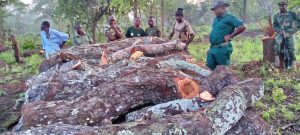
Government in 2017 deployed soldiers to man the forests but years down, the interventions have not been very successful and million of trees continue to be cut down wantonly.
Averagely, In Malawi about 33,000 hectares is deforested every year according to a research by Patrick Kambewa and Henry Utila. This among others include the forestry encroachers for charcoal burning and timber smugglers to across borders.
Such practices are particularly detrimental to forest reserves like Dzalanyama, Perekezi, Chimaliro, and Nkhotakota. In Karonga District, which borders Tanzania.
Issues of illegal charcoal and timber exportation to Tanzania and beyond are not new. A tour of the forests along the Songwe River and nearby areas reveals that the trees are nearly depleted.
The secret business
Mercy Lupakisho, 45, hails from Mwenengolongo Village in Traditional Authority Mwakaboko in the northern district of Karonga. For over a decade, she has known no other business apart from selling charcoal.
She proudly states that her business has thrived for over 10 years, providing good income that helps her take care of her home and pay school fees for her children.
As she narrates her experience, Lupakisho mentioned that she has never sold her charcoal to Malawian customers, but only across the border to Tanzania.
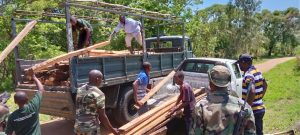
During a day spent with her as she gathered her bags of charcoal at the Songwe border, she refused to sell within her locality. “In Malawi, we sell about US$8 per 50-kilogram bag, while in Tanzania it fetches triple the price, around US$20, which is more profitable.
This allows me to support my family and children. I manage to educate my children, with some currently in secondary school,” said Lupakisho.
Mercy is just one among several people who continue to benefit from the forestry products through charcoal business. The practice has eroded the forests lying along Songwe border area with Tanzania
Investigations have showed that Forest regulations of 2004 in Tanzania strictly prohibits cutting down trees for timber charcoal among other products. This has made the Tanzanians staying in the borderline to rely on timber and charcoal from Malawi a thing which has accelerated deforestation.
The criminal networks and contract charcoal burning by Tanzanians have led to significant environmental depletion in Malawi.
“We use the same Songwe border to enter Tanzania, especially early in the morning before offices open, and the guards let us pass. Sometimes, I give them around US$2, and they let me through with my charcoal.
“When we get to Tanzania, nobody asks us anything, especially if the charcoal is from Malawi. It is hard to get charcoal in Tanzania because they do not allow charcoal burning or
cutting down trees. Hence, they rely on Malawian charcoal, and for over 10 years, this has been my business,” said Lupakisho.
Lupakisho noted that compared to the past five years, charcoal is now becoming scarce at the border because the trees have been depleted, forcing people to travel long distances to find them.
In addition to charcoal, timber is also highly exported to Tanzania. In 2023, the Karonga District Forestry Office managed to crack down on illegal timber exportation as well as charcoal, according to Kingston Kamunkhwala Tembo from the Karonga District Forestry Office.
Tembo explained that smuggling timber and charcoal to sell in Tanzania has been a longstanding issue and a difficult battle to fight because the community is often hostile towards enforcement efforts.
“The District Forestry Office has always worked hard to combat this malpractice, together with the police and local chiefs, but it has not been an easy ride,” Tembo said.
Malawi’s Charcoal in Tanzania
Tembo disclosed that Tanzanian forestry officials do not crack down on Malawian charcoal sellers, allowing them to operate freely if the charcoal originates from Malawi. This leniency has encouraged the sale of charcoal in Tanzania, leading to the depletion of forests on the Malawian side.
“If you stand and look at the Tanzanian side, you will see that the trees are quite intact, unlike on the Malawian side where all the trees are gone. Not even one is remaining,” Tembo explained.
“Worse still, vendors from Tanzania come to remote Malawian villages and contract locals for charcoal burning, promising them better money than they would earn selling locally. Once they get the desired tonnage, they use uncharted routes to smuggle the charcoal into Tanzania,” said Tembo
Tembo stated that his office has attempted to crack down on these charcoal sellers but has struggled due to the vendors’ effective communication networks, which alert each other when forestry officials are patrolling their areas.
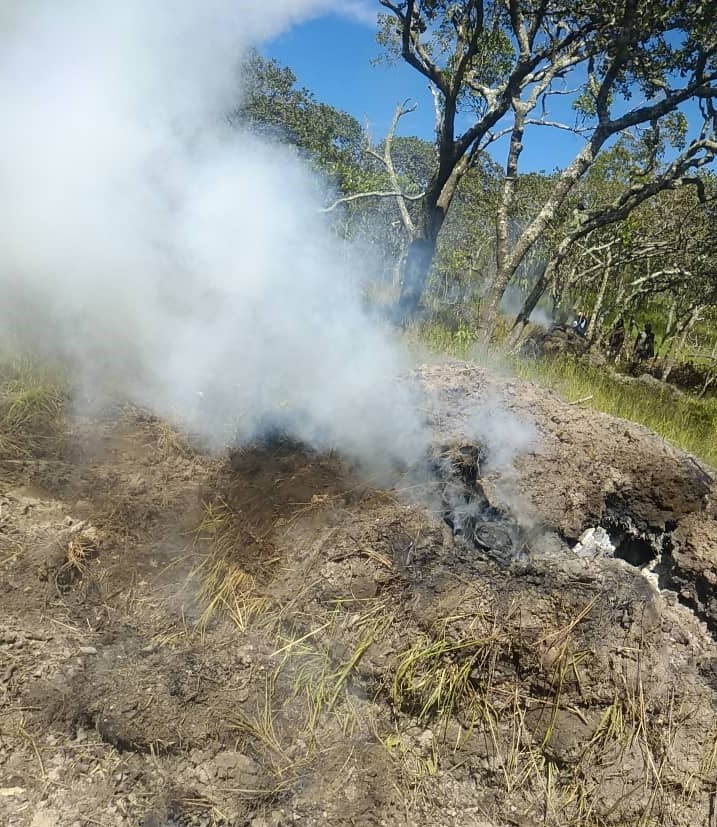
“We have organized patrols, but we often end up finding no charcoal vendors. The vendors are consistently communicating, making it very hard to intercept their smuggling routes. We have also worked with local chiefs to combat the illegal sale of charcoal and timber to Tanzania, and many are aware of these issues,” Tembo said.
Despite this, Tembo noted that while chiefs do not always discourage charcoal production, they are gradually becoming more concerned and are beginning to take active roles in addressing the issue.
Traditional Authority Mwakaboko highlighted that the illegal transport of charcoal to Tanzania is particularly rampant at the Songwe border with Tanzania.He said the Tanzanians are taking advantage of Malawi because their laws are stiff and do not accept charcoal burning or cutting down trees even if the trees are planted at one’s household.
“The Tanzania vendors have taken advantage of the weak enforcement of our laws, and they continue to encourage charcoal burning in Malawi thereby depleting our forests in the birder areas with Tanzania,” said Mwakaboko.
Lack of political will fuelling the malpractice
Tembo pointed out that lack of political will on the side of government is frustrating the fight against deforestation in the country.
He said despite the amended forestry law on forestry products which was passed by the Malawi Government in 2020 with stiffer penalties but still charcoal and timber are being illegally produced and sold.
“Lack of political will is frustrating the fight. When we arrest the vendors, we get calls from politicians demanding release of some people, so these are some of the factors affecting the illegal charcoal and timber business across to Tanzania.
“It is not only charcoal going to Tanzania but even hardwood timbers. In early last year we arrested one with a lorry packed trying to cross the border. We managed to arrest him, and the issue went to court. I feel it would be good if the government officials at higher level meet and discuss to sort out this charcoal issue,” said Tembo.
Illegal Charcoal, Timber: An African Problem
In Uganda, President Yoweri Museveni, issued Executive Order No.3 in May 2023. Followinf the order, environmentalists were excited because it included a ban on commercial charcoal production. However, as soon as the order was issued, dealers devised cunning strategies to stay in business.
In Northern Uganda, where there is high forest cover and community woodlots, the trend has shifted regarding how charcoal is transported from deep in the villages to the towns where it is loaded.
Since the start of the ban, traders have relied on motorcyclists who abandoned their former business of carrying passengers for the charcoal trade.
On a district road leading from rural areas to town, one can observe motorcycles carrying three bags of charcoal passing by every 40 minutes.
Calvin Okello, a 32-year-old, is among those who have joined charcoal transportation, claiming to earn more than from his previous occupation. Okello makes two trips daily, transporting a total of six bags. In a month, he carries an average of 200 bags, occasionally making three trips a day.
He told Greater North News Agency that each bag is sold at UGX 40,000 (USD 10.8), making a profit of UGX 20,000 (USD 5.4).
Due to high demand from traders invading lucrative areas like Gulu City, once a cyclist delivers the charcoal, it is immediately loaded into waiting Fuso trucks parked along Lango Road in Bardege-Layibi division.
Robert Mugume, a 28-year-old who was hesitant to share information, said, “It is better to wait for charcoal from town than go deep into the villages. “I just buy from other traders then I go back to Kampala for fear of having our stock impounded and threats to burn our truck,” he said.
Uganda charcoal in Kenya
For over the years, Kenya has been the driving force of deforestation in Uganda but in 2017, Kenya suspended logging in all forests across the country, a ban on charcoal trading was issued for three months, now extended to six months.
An East African online publication detailed how Kenyan charcoal traders have been coming to Uganda since the ban. The May 2019 article noted that selling charcoal to Kenyan traders is more profitable for Ugandan dealers.
A sack of charcoal costs at least USD 15 in Uganda but rises to USD 22 when sold to Kenyan traders.
Agnes Nakato, a charcoal dealer from Central Uganda, has been in the trade for five years. She told GNNA that a bag of charcoal in Kampala sells for UGX 80,000 (USD 20). She’s heard from colleagues who smuggle charcoal through the porous borders of Tororo and Busia districts that it sells for UGX 120,000 (USD 32) in Kenya.
A March 2021 report by the Global Initiative Against Transnational Organized Crime highlighted Uganda’s significant role as a regional producer of charcoal, with main production sites in the northern regions of West Nile and Acholi.
The report also noted that reforestation efforts are hindered by a lack of funds and interest from landowners and charcoal producers.
In January 2024, the government through the Ministry of Water and Environment (MWE) secured 40 million euros (shs165.7b) to facilitate plans to restore the lost forest cover in northern Uganda.
Malawi’s intervention and reforestation
In February 2020, the Malawi government, through Parliament, passed the Forestry Amendment Act to regulate charcoal selling. This legislation requires applicants to obtain licenses by successfully submitting a reforestation plan or a forest management plan approved by the Director of Forestry.
The amended act also fosters a conducive environment for the participation of forest-dependent communities and the private sector in forest management in Malawi. Additionally, it grants certain prescribed forest officers the authority to use firearms to effectively conduct law enforcement activities under the act.
Recently, the Minister of Natural Resources and Climate Change, Dr. Michael, highlighted that the high demand for illegal and unsustainable charcoal in urban areas is depleting the country’s forests.
In January 2024, environmentalists criticized the minister for not taking sufficient action to address the deforestation caused by illegal charcoal production.
However, during the launch of the National Tree Planting Season in Blantyre District, the minister issued a stern warning to individuals involved in the illegal destruction of trees for charcoal.
In 2024, the Ministry of Natural Resources and Climate Change, has planted about 34 million trees across the country.
Through AFRI 100, Africa’s locally led land restoration movement, Malawi is scheduled to restore 4.5 million hectares of degraded land by the year 2030.
This story is supported by the Environmental Reporting Collective (ERC) to trace environmental crimes across borders.
