
By Dr Charles Leyman Kachitsa
Starting from the time of creation, humans have had a life where they are given choices. We could go far back to the first man and woman created and the story is that they were given a choice to live in splendour and dominion as long as they do not go for the bad choice denied them which was leaving everything else they were promised, instead going on to eat the forbidden fruit. The rest of the story as you are aware takes us where we are in the world today!
Despite second chances, there is the tendency in human beings to go back to their own chosen settings. Such a choice normally takes on a cyclic pattern as it leads to relief for a short time but more often gets back to the original condition. Some quarters stated that humans love their pain, love those painful experiences. Deeper understanding and enlightenment is required for one to keep afloat on the pane of the original purposed life as the creator intended for all living on this earth, the ‘promise’.
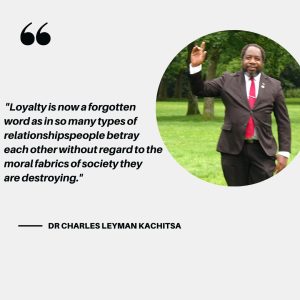 All is not lost as life continues to be open, giving the same choices as were there before. It only needs a people to open their own eyes and be receptive to the high powers above constantly edging us to stop and rethink, stop and re-imagine. Imagining what a better world will look like in a garden full of life and encouragement to live fully dominant. In the end there are only two choices in any situation on earth, light or darkness.
The quotes for this week are taken from a book narrating the transitions of some African nations from the undocumented period on to the times others have claimed they had discovered them. It shades light on some of the questions people ask on how these countries have turned to the status they are now. I am sure the few chosen quotations listed below from the book will enlighten you to one or two life lessons. Read and enjoy:
AN INTRODUCTION TO THE HISTORY OF CENTRAL AFRICA – ZAMBIA, MALAWI, AND ZIMBABWE by A.J. Wills
“The names by which regions are known have frequently been bestowed upon them by travellers from informed societies outside coming to explore them, or else by second-generation pioneers who follow.”
“……… Central African territories are not organic nation states that have matured through centuries of common heritage, but artificial creation of external forces. Their future form and the future relationship between them must alter and adapt as the realities beneath the surface of contemporary politics assert themselves. This is an age of transition, no where more so than in Africa. The rapidity of the change is bewildering, and a sense of proportion is greatly needed among the people of all races whose lives are caught up in the maelstrom of change.”
“The generalization ‘Africa’ embraces wide variety. Travellers south of the Sahara have discerned common factors in contemporary human tradition, in climate, vegetation and animal life. Such common factors undoubtedly exist, due both to the geographical position of the continent that lies across the equator and duplicates its climate conditions north and south, and to the originally migratory character of its indigenous people who, though spread over a vast area, possess a related origin. Generalization cannot however eradicate infinite diversity, and is made less justifiable by recent events. The impact of exotic cultures has tended to divide where an over-all unconscious unity existed. ………”
“During the last three centuries B.C. a number of circumstances was combining to disturb these fringe communities and push them southwards, some into the forests of the Congo and its tributaries, others, the more pastoral and Hamitic, towards the great lakes, the rift escarpment and the East African highlands. What these circumstances were we must largely speculate, but three were most probable: the further desiccation of the Sahara, a process already centuries old in the present phase, a background trend; second, the southward shift of the Cushite power in the sixth century B.C. following the Assyrian conquest of Egypt; and lastly the spreading knowledge of iron, the Iron Age revolution, brought to Egypt by the Assyrians, and absorbed as a feature of the Cushite economy on the upper Nile by the fourth century B.C.”
