
By Wanangwa Tembo
Martha Mphale leads a group of 22 women who gather under the umbrella of Guchu Cluster, which apart from owning small agribusinesses, also owns and runs a village savings and loans (VSL) group in Traditional Authority Wimbe in Kasungu District.
The women, or their husbands, are amongst the 24,000 participants under the Climate Smart Public Works Programme (CSPWP), an environmental restoration initiative and component of the Social Support for Resilient Livelihood Project (SSRLP) being supported by the World Bank and the Multi-Donor Trust Fund.

Mphale says the rising costs of farm inputs, coupled with land degradation and erratic rains, had turned their once food secure households to perennially hungry and vulnerable families.
“All along our farming has largely been subsistence in nature, but at least we used to harvest something to meet our food needs; but in these recent years, the harvests have been so poor that we have become chronically hungry people.
“The reasons could be many, but major ones include the rising costs of inputs, especially fertilisers and seeds, and that our farms are long degraded,” Mphale says.
This season, however, Mphale’s gardens resemble a thick forest, beaming with beautiful maize crop, telling a promising story that will change the family’s food politics.
Her experience is also shared by Enita Mwanjeni, a mother of 10 from Zambara Village, in the same area, who is also a member of Kachule Cluster.
Mwanjeni, whose husband is enrolled in the CSPWP under Mwayeka Conservation Catchment, is for the first time in years expected to harvest more than her food needs and wean the family from perennial hunger.
“I have three acres of maize. I planted white maize in two of the acres and orange maize in the other.
“The crop has done very well and I’m excited that this year, my household will have enough food and some surplus to sell,” she says.

For the two, just like the rest of the members, their stories changed following interventions by the Community Savings and Investment Promotion (COMSIP) Cooperative Union Limited which is implementing a livelihood component of the SSRLP, targeting participants under the CSPWP and beneficiaries of Social Cash Transfer Programmes (SCTP).
The CSPWP is a social protection initiative targeting poor households with labour, and they are involved in soil, water and forests conservation while earning K48 000 per month. On the other hand, the SCTP targets poor but labour-constrained households who receive varying amounts of stipends per months.
Both programmes fall under the SSRLP which government implements through local councils and it is overseen by the National Local Government Finance Committee (NLGFC).
Mphale and Mwanjeni, including all members of Guchu and Kachule Clusters, benefitted from COMSIP’s Legumes Enterprise Structured Program (LESP), where VSLs and cooperatives received farm input support matching grants for the purchase of seed and fertilisers in the 2024/25 growing season.
At least 844 groups, of which 82 are in Kasungu, have benefited from the initiative countrywide.
“This fertiliser was not meant to be applied to crops in its raw form. We were to use it as an ingredient to make mbeya manure. So it is this mbeya manure that has given us this good crop you see in our gardens,” Mwanjeni says.
For example, members of Guchu Cluster contributed K1.8 million which earned them K6.075 million from COMSIP to produce about 100 bags of manure, which they shared four apiece.
According to COMSIP District Coordinator for Kasungu, Christina Josiya, COMSIP has invested K2.6 billion in the LESP initiative during the 2024/2025 farming season, where funds accessed from the grant were used to purchase farm inputs, including fungicides, pesticides, masks, sprayers, fertilizers and seed.
“The arrangement is that beneficiaries contribute 30 percent of the total costs of the inputs while COMSIP provides the remaining 70 percent.
“Inorganic fertilisers are ingredients in the making of mbeya manure. So we get the money and buy fertilisers which the beneficiaries use to make as many bags of mbeya to apply to their crops,” Josiya says.
She says the farmers are encouraged to procure certified seed of orange maize because of its high nutrient content.
“Apart from maize, we also encourage them to cultivate beans and soybeans and, as you can see in the gardens, we are on the right track because the harvest is very promising.
“The good thing with manure is that it replenishes the degraded soils and retains moisture longer for crop survival even when the rains haven’t been good enough,” she says.
Josiya adds that COMSIP is expected to be the off taker of the produce under LESP, and will help to identify other good markets for the participants to benefit from their labour.
At least 15 districts of Chitipa, Karonga, Rumphi, Nkhata Bay, Mzimba, Kasungu, Nkhotakota, Ntchisi, Dowa, Lilongwe, Dedza, Balaka, Blantyre, Chiradzulu and Phalombe have benefitted from the programme, which is expected to roll to the rest of the district in the coming 2025/26 growing season.
To complement the produce, COMSIP has also trained the households to cultivate various agronomic crops such as beans, vegetables, fruits, tomato, pepper, onions, eggplants and others in backyard gardens where they are planted in the same plot side by side, an approach known as permaculture.
In agro-sciences, permaculture is a design system modeled on natural ecosystems to create sustainable and resilient systems for agriculture, land management and community living, drawing inspiration from the way natural ecosystems function, where all parts are interconnected and work together to create a balanced and productive environment.
It aims to create systems that are sustainable and can continue to provide resources and support life without being depleted or damaged hence the crops under the approach do not require inorganic fertilisers.
Jacob Masitala, a 28-year old farmer from Mphelo Village in the area of Traditional Authority Chambwe, offers a good case on how permaculture has benefitted the communities under Tisamalane Cluster in the area.
“My backyard garden has vegetables such as rape, mpiru, beans, eggplants, tomato, and fruit trees and are planted side by side to ensure there is interdependence among them.
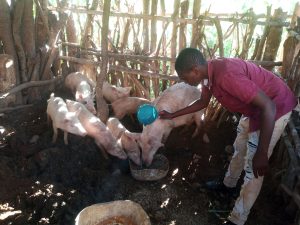
“I don’t apply fertiliser, instead, I use manure harvested from the livestock which I procured with the earnings from CSPWP. So everything is organic and we don’t apply any chemicals,” Masitala says.
He says since he was trained in the farming approach, he has saved money that was being spent on fertiliser and relish for his households.
“We don’t buy vegetables; we just pick them from our garden and the good thing is that they are of different types whereby we can choose to eat rape today, eggplants tomorrow, mpriru the other day and so on.
“It’s a productive cycle whereby we get manure to apply in the garden, eat or sell the produce thereby saving money. Likewise we can decide to eat or sell the livestock,” he says
From zero two years ago, Masitala has now accrued 20 pigs, 10 chickens, 16 pigeons, six ducks, and he is planning to add goats to the list of his livestock.
“Apart from these ventures, I’m also a member of the Tisamalane VSL group. I find it easy now to contribute my shares because I have a lot of things that I sell for money,” he says.
Masitala concludes with an advice to beneficiaries of social protection initiatives calling on them to save the little they get from government.
“That money must be invested. It’s capital for further projects. If we get into groups and allow the money to multiply, we can acquire assets such as livestock which will help us get manure and apply in crops.
“This is a productive chain that quickly becomes self-sustaining,” he says.
