
By Vincent Khonje
From August 5 to 8, the Awaza Tourist Zone in Turkmenistan received visitors from across the world.
The visitors were not tourists but delegates who went there for the Third United Nations Conference on Landlocked Countries (LLDC3).
There are 32 landlocked countries in the world, and 16 in Africa. However, the conference also had countries that have access to ports, which are very important to the landlocked countries as transit countries.
Malawi’s President Lazarus Chakwera delegated Vice President Michael Usi to the conference, and while there, it was not only about accessibility to ports, but also opportunities to cement bilateral relationships.
Although taking place thousands of kilometres away, the conference was of paramount importance to even local Malawians.
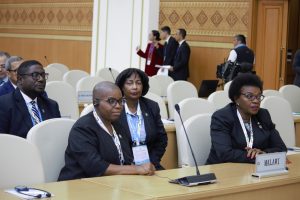
“The conference is beneficial to Malawians because the challenges that we encounter in accessing the ports are felt in the pricing of the commodities that Malawi gets: and this trickles down to the common Malawian,” said Usi.
After arriving in the Capital City of Turkmenistan, the Vice President took a one-hour flight to Awaza for the meeting.
A warm welcome from the Government of Turkmenistan proved that the country was open to people from other countries.
Usi had tasks lined up, and after arrival in Awaza on Monday, August 4, 2025, the Malawi delegates had already prepared to deliver at the conference.
Among top government officials from Malawi were Permanent Ambassador to the UN, Agnes Chimbili Molande, the country’s Ambassador to the state of Qatar, Roy Kachale, Principal Secretaries from the ministries of Transport, Madalo Nyambose and Anjimile Mtila.
The Vice President took his first official task on Tuesday, August 5, when he contributed to the general debate after the official opening of the conference.
The debate also bordered much on the Awaza Programme of Action (APoA) for LLDCs for the Decade 2024 to 2034, adopted by the UN General Assembly on 24 December 2024.
The APoA represents a renewed and strengthened global commitment to support the development aspirations of the 32 LLDCs located in Africa, Asia, Europe, and South America.
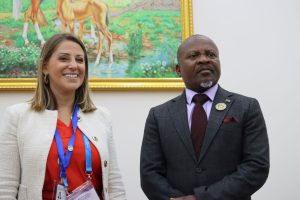
Drawing on lessons learned from the Vienna Programme of Action (2014 – 2024), it seeks to ensure that progress accelerates, especially in such areas as trade facilitation, structural transformation, transport connectivity, technology, climate resilience, and the mobilisation of international support.
Usi tackled the importance of digital connectivity, saying Malawi has initiatives to expand rural network coverage and introduce digital skills training for youth and entrepreneurs.
The Vice President said the APoA is, therefore, both timely and necessary.
“It reflects lessons learnt from the Vienna Programme and offers a renewed global commitment to the aspirations of the 32 landlocked developing countries in the world,” said Usi while calling for development partners to honour their commitments and partner with Malawi in unlocking full potential.
The hot conditions of Awaza did not stop the Veep from taking his second official task when he contributed to the roundtable discussion titled ‘Seizing the transformative potential of trade, trade facilitation and regional integration for landlocked developing countries’.
Then, a high-level press briefing was called to brief the media on the establishment of the negotiating group under the United Nations Framework Convention on Climate Change (UNFCCC), which is the first tangible deliverable of this Awaza PoA.
It briefed the media on the establishment of an LLDC negotiating group under the UNFCC, which is the first tangible deliverable of APoA and a critical step toward ensuring that the specific vulnerabilities of the LLDCs are reflected in global climate decision-making.
The climax was when Malawi’s Second Citizen co-chaired a discussion with Bhutan’s Minister of Foreign Affairs, Dina Nath Dhungyel, titled ‘Enhancing Adaptive Capacity, Strengthening Resilience and Addressing Vulnerability to Climate Change and Disasters in Land Locked Developing Countries.’
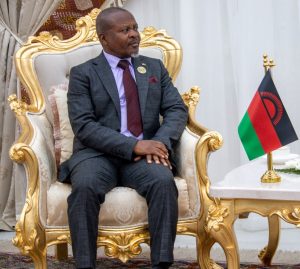
Kick-starting the discussions, Usi said Malawi is investing in climate-smart agriculture, and mainstreaming a disaster risk management approach into all policies, with access to climate finance remaining a barrier.
He called for full operationalisation of the loss and damage fund, which is a financial mechanism designed to provide support to vulnerable countries, particularly developing nations, in addressing the impacts of climate change that go beyond what they can adapt to.
His co-chairperson, Dhungyel, echoed Usi’s remarks on financing, saying the loss and damage fund would make sense if it were easily accessible.
“The impact of the fund can make much sense if its accessibility is also as simple,” said Dhungyel.
Malawi, as a country, not only benefited from directly taking part in deliberations and debates, but also from bilateral engagements, taking advantage of countries and development partners.
Another highlight was when Usi, met with the President of Turkmenistan, Serdar Berdimuhamedow.
The two had a meeting which bordered on several issues of cooperation and development between the two nations.
“We had a very fruitful discussion in many areas of cooperation in education and Digitalisation. We also looked at development issues that can be further explored,” he said.
Cementing on the meeting with the Turkmen President, led by Malawi Ambassador to Qatar, Roy Kachale, Malawi has signed a Protocol on political consultations between the Ministries of Foreign Affairs of Malawi and Turkmenistan, which Usi witnessed.
The MOU deepens Malawi-Turkmenistan bilateral relations and explores funding for Malawi’s developmental projects, especially in areas that Turkmenistan has expertise, such as energy, infrastructure and education.
The Malawi team also had bilateral talks with Rabab Fatima, Under Secretary, UN Office of the High Representative for the Least Developed Countries, where the two parties discussed Malawi as chair of UNFCCC, and the DPoA mid-term review.
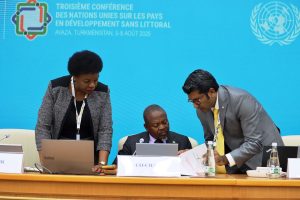
Another bilateral relationship was yoked with the UN Capital Development Fund (UNCDF).
The aim is to exchange views on how UNCDF’s unique capital mandate and country-level financing instruments can support Malawi in translating the priorities of the Awaza programme into bankable initiatives aligned with the national development agenda.
The Vice President also met Ana Isabel Xavier, Secretary of State for Foreign Affairs and Cooperation of Portugal, where they discussed multilateral affairs of mutual interest for the two countries.
Summing it up all Malawi’s Permanent Secretary to the UN, Chimbili Molande, said the deliberations explored strengthening international cooperation and identifying innovative partnerships to enhance the development and aspirations of landlocked developing countries.
“The outcome of the conference is that the LLDCs need public and private partnerships or investments, new and innovative partnerships, not the old types, but new ones, like including government being in partnership with the private sector, innovative financing mechanisms like what we are calling blended financing, green bonds, and blue bonds,” she said.
For Malawi, priority areas have been set that will need to be implemented, like unlocking borders to ensure that farmers and entrepreneurs, small and medium or large, are connected to local, regional and international markets, transforming economic structures and systems using new technologies to unlock economic opportunities.
The other priority is establishing regional agricultural research hubs to ensure that the landlocked countries adopt evidence-based climate-smart agriculture, strengthening the disaster early warning systems for early climate action so that communities escape disasters like cyclones, and lastly, adoption of digital technologies such as artificial intelligence.
