
By Khumbo Msambala Salanje
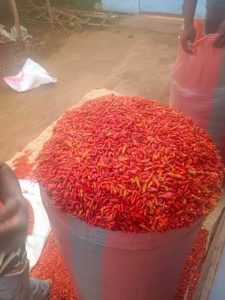
In a small field in Kasungu, rows of Chili plants sit heavily laden with fruit, their bright red pods catching the afternoon sun in a modest fashion easy to overlook amid the traditional maize and tobacco fields that define this district.
Yet what grows here, quietly and in small quantities, has become one of the strangest puzzles in Malawi’s agricultural economy.
When the government announced the 2025/26 minimum farm-gate prices, Chili stood out at K7,000.00 per kilogramme, fetching the highest minimum price of any crop and surpassing traditional cash crops.
The price signalled the crop’s immense commercial value yet, despite the attractive price and growing international demand, Chili production in Malawi remains strikingly low.
“There are very few Chili farming cooperatives in Malawi because most farmers lack information about the crop and they do not have access to reliable markets, especially international markets,” observes Enalla Kanteleka, member of the Kasungu Chili Cooperative.
Many chili producers struggle to find dependable markets beyond a handful of buyers; and for farmers in Kasungu, this is more than a missed opportunity as it reveals a value chain that is yet to receive the attention needed to unlock its potential.
Kanteleka believes Malawi could significantly increase foreign exchange earnings if Chili farming received the same policy support accorded to other cash crops.
According to the farmer, demand for Malawian chili continues to outweigh supply as production remains low due to few farmers willing to venture into a crop with uncertain markets.
Kanteleka attributes the farmers’ hesitation, in part, to a deeper structural problem that she thinks limits government’s commitment to developing the chili industry.
“There is little government commitment in promoting Chili farming at national level through interventions such as grants and affordable loans specifically for large-scale Chili production,” she observes.
For Kanteleka, chili should no longer be viewed as just another horticultural crop: Instead, she believes it deserves recognition as a strategic cash crop capable of contributing to Malawi’s foreign exchange earnings, alongside tobacco.
Another farmer, Spellina Makina, who has grown chili long enough to know both its rewards and its frustrations, says the crop offers attractive returns while it requires relatively less labour than many other crops.
“Chili farming is rewarding and it is not as demanding as many people think,” explains Makina, and she continues: “However, access to markets remains our biggest challenge because we mostly rely on off-takers.”
Makina further notes that dependence on a limited number of buyers leaves farmers with little negotiating power, often forcing them to accept prices determined by vendors rather than by open competition.
The farmer believes that opening up more local and international markets would encourage many more farmers to venture into chili production.
But from the farms of Kasungu to the offices of Malawi’s Chili Exporters in Salima, a strikingly different narrative emerges.
While chili producers claim to be struggling to find buyers, exporters, on the other hand, say they are struggling to find enough farmers to satisfy an already existing market.
 Chawanangwa Munthali, proprietor for VICKAM Products, says he has been trading in chili since 2016, exporting to Malaysia, Germany and the Netherlands, but the company continues to face difficulties sourcing adequate quantities from local farmers.
“We mobilize Chili growers, provide them with seed, technical capacity building and buy their produce at competitive prices,” explains Munthali, and continues: “Chili is one of the most profitable agricultural value chains because it requires relatively low inputs, while offering very high gross margins.”
Monthly, VICKAM is currently buying chili from farmers at a minimum of US$5 (about K8,680) per kilogramme, exceeding the government’s minimum farm-gate price of K7,000 per kilogramme for quality produce destined for export.
“The challenge is not the market. The challenge is that we have very few farmers producing chili, making it difficult to source the volumes required by international buyers,” he says.
It is this gap, between the demand abroad and the supply at home that VICKAM is now striving to close.
The company has launched an initiative called Mission Triple 30, which seeks to mobilize 30,000 chili growers capable of producing 30,000 tonnes of quality produce by 2030.
According to the chili entrepreneur, the early results of the Mission Triple 30 have been encouraging.
“We are only two months into the initiative, but the response has been overwhelming: We have already registered more than 4,000 growers,” he explains.
The company operates across the country, supporting farmers with seed, technical training and guaranteed markets.
Among the groups VICKAM works with is the Kasungu Chili Cooperative, where Kanteleka belongs, a small but telling sign of how private-sector intervention is beginning to reach the ground.
For Munthali, Chili represents far more than a niche horticultural crop.
“This is a value chain that can substantially generate foreign exchange for Malawi if production is increased,” he explains and adds: “Our goal is to become leaders in the chili value chain, while creating opportunities for thousands of farmers.”
The concerns raised by farmers are not entirely disputed by the government.
In a written response through the Ministry of Agriculture, Irrigation and Water Development’s Public Relations Officer, Salome Gangire, the ministry acknowledges that chili has historically received less attention than crops such as tobacco, tea, sugarcane and groundnuts.
According to the ministry, this is because these commodities already had established production systems, institutional support and export markets.
The ministry also acknowledges that fragmented production, inconsistent quality, low production volumes and weak market organization have limited the development of a competitive export oriented Chili value chain.
Still, officials say the picture is beginning to shift: The government now recognizes Chili as an emerging high value horticultural crop and it is strengthening efforts to commercialize the sector.
Among the interventions cited are linking farmers to structured markets through productive alliances; supporting farmer cooperatives and aggregation centres; promoting value addition and agro processing; and facilitating export market awareness.
Other steps include encouraging irrigation farming; and fostering partnerships between farmers and private investors.
The ministry further acknowledges that agricultural extension officers across the country are promoting chili production under broader horticultural programmes.
 “The Ministry is also working with institutions responsible for export promotion to improve farmer capacity in grading, packaging, quality standards and export readiness, while encouraging investment in processing facilities,” reads the written response from the Ministry of Agriculture, Irrigation and Water Development.
According to the Ministry, Government is actively promoting private sector investment in high-value horticulture, including chili production, processing and export.
“Through commercialization programmes and investment promotion initiatives, Government is encouraging partnerships between farmer organizations, processors, exporters and agribusinesses,” continues the response.
“Several private companies are already working with smallholder farmers through contract farming, providing technical support, quality assurance and access to export markets,” the Ministry adds.
However, the Ministry acknowledges that investment continues to be constrained by inconsistent production volumes, limited irrigation infrastructure, inadequate processing capacity, high transport costs and challenges in meeting international quality and phyto-sanitary standards.
Both farmers and exporters agree that chili market is readily available with buyers waiting, dangling attractive price tags as demand exceeds supply, yet, failure to produce enough and quality chili remains a stumbling block.
As Malawi continues searching for new sources of foreign exchange, and as the country seeks to diversify its agricultural exports, the country’s overlooked chili sector presents a compelling question: What’s preventing Malawi from turning one of its most valuable crops into its next major export success?
For farmers like Kanteleka and Makina in Kasungu, the answer may lie less in the soil than in the systems meant to support them, and in whether Malawi is finally ready to treat chili not as an afterthought, but as the strategic crop that its price tag already suggests it is.
